PTSD: It’s Not Just Psychological
- PTSD isn't just "in your head." Trauma can create real, measurable changes in the brain, stress hormones and nervous system.
- Anyone who experiences severe trauma can develop PTSD, not only combat veterans or first responders.
- PTSD symptoms fall into four clusters, including re-experiencing, arousal, avoidance and mood symptoms that can disrupt daily life.
- Evidence-based PTSD care can help retrain the brain, ease symptoms and support lasting recovery.
- Salma Health's integrated approach to PTSD care brings diagnostics, outpatient care, IOP, medication support and advanced treatment options together under one roof.

Traumatic experiences can alter the brain to the point that it severely impedes a person’s ability to function. Through an integrated system of PTSD care that leverages the overlap between trauma and anxiety in the brain, Salma Health assists these individuals on their healing journey.
For many, post-traumatic stress disorder (PTSD) evokes images of veterans haunted by flashbacks and other forms of severe anxiety as a result of horrific battlefield events, their psychological ordeal enduring long after they return to civilian life. But, while combat soldiers are at heightened risk, anyone who experiences or witnesses life-threatening or otherwise severe trauma is susceptible to this debilitating condition. What’s most important to recognize is that PTSD isn’t merely psychological — and overcoming it isn’t as simple as “getting over” the bad memories.
“When we measure stress hormones in the blood and urine of people with PTSD, we can see biological changes,” says Ian Kratter, M.D., Ph.D., a Stanford neuropsychiatrist who advises Salma Health. “There are clear signs that biological changes have occurred in the brain that are resulting in this dysfunction.”
In addition to combat veterans, people who may be prone to developing PTSD symptoms include individuals who have been victims of physical, sexual or emotional abuse; first responders exposed to tragic accidents or grueling crime scenes; and survivors of natural disasters or acts of terrorism. “Fortunately, most people who experience trauma don’t go on to develop PTSD,” Dr. Kratter says. “But many do, and we don’t fully understand why it occurs in some cases and not in others.”
PTSD symptom clusters
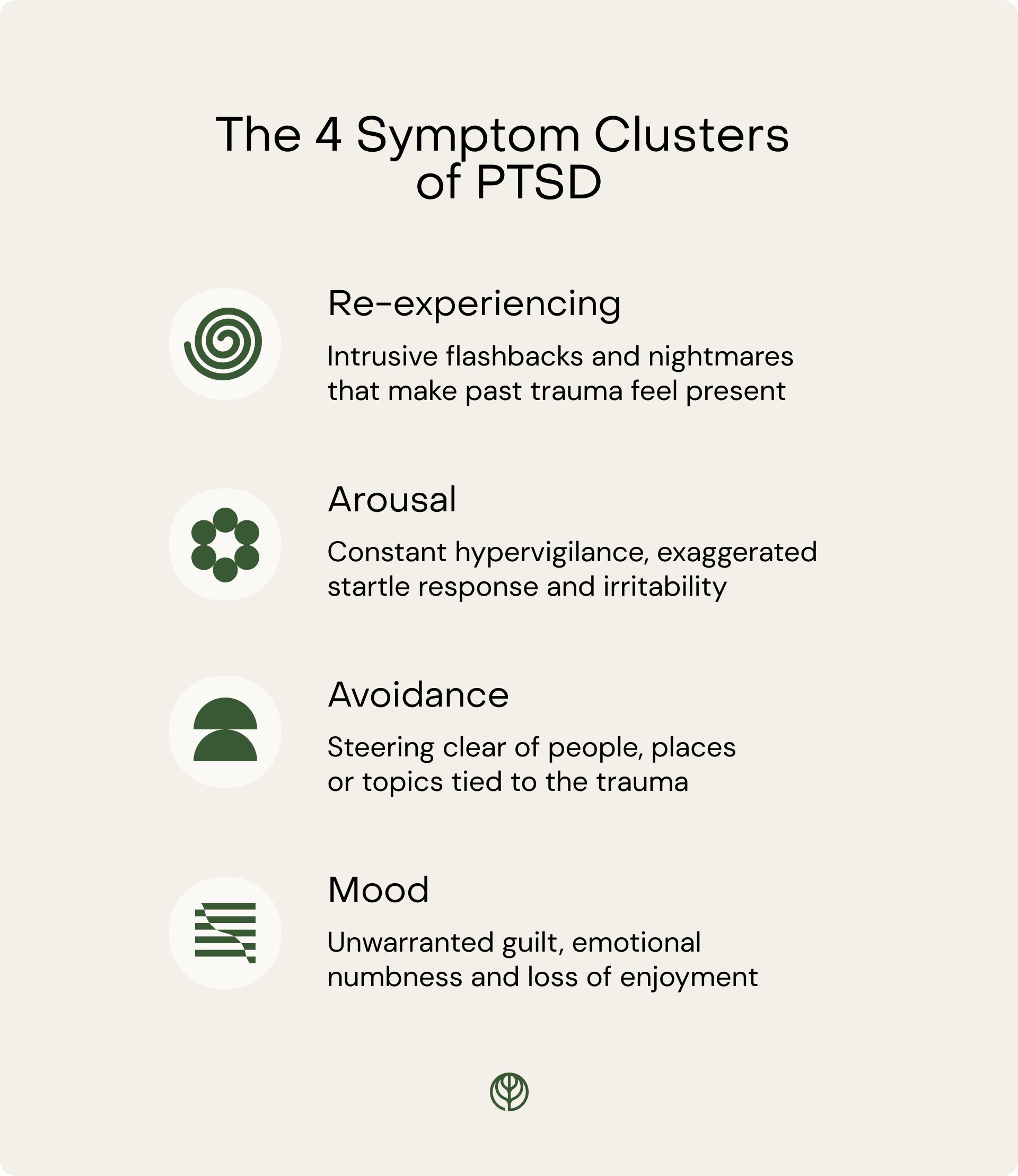
A diagnosis of PTSD is made when symptoms last more than a month and are associated with significant distress and/or impaired functioning. Dr. Kratter explains that the symptoms generally fall into four clusters:
- Re-experiencing symptoms include flashbacks or nightmares in which the individual repeatedly returns to an element of the trauma as if it’s occurring anew.
- Arousal symptoms are characterized by hypervigilance — being on guard for a potential threat when there is no logical reason to think one exists. The person may show exaggerated startle reflexes along with being constantly on edge, irritable and quick to snap at others.
- Avoidance symptoms involve extreme efforts to stay away from any reminders of the trauma, including the specific place where it occurred, or the people or conversation topics likely to trigger traumatic memories.
- Mood symptoms are associated with negative self-beliefs — the feeling of having deserved a trauma the person was in no way culpable for — along with a loss of interest in activities and an inability to experience joy.
How trauma and chronic anxiety overlap in the brain
As with depression and other brain health issues, these symptoms aren’t just matters of the mind; they are manifestations of identifiable changes in the neurocircuitry. “Patients with PTSD seem to have a dysregulation in the hypothalamic-pituitary-adrenal [HPA] axis, which is how our brain signals to our body to make stress hormones,” Dr. Kratter says. “When inappropriately regulated, it can produce enhanced stress responses to what should be normal situations.”
That dysregulation of the body’s stress-response system is one of the ways in which trauma and chronic anxiety overlap in the brain. “A commonality among anxiety disorders is that when we’re anxious, our fight-or-flight system gets revved up,” Dr. Kratter notes. “In the case of PTSD, it can be revved up by nothing more than a recollection of an event. Evolutionarily, being attuned to threats has been an important survival mechanism. But in PTSD, what started as an adaptive, helpful response goes haywire.”
This shared circuitry has implications for the treatment of PTSD, which aims to reduce anxiety and retrain the brain’s response by fostering new connections that move past the rumination and negative feedback loops characteristic of so many brain health disorders. The therapeutic “rewiring” can take many forms, and the treatment or combination of treatments that will work best depends on the symptoms, preferences and biology of the patient.
PTSD treatments
Evidence-based psychotherapies
The first line of evidence-based PTSD treatments consists of various types of psychotherapies. Among the mainstays is prolonged exposure therapy, which helps the individual begin to tolerate the past trauma through a gradual revisiting of the trauma-related cues, reducing the stress by reconditioning the brain to understand that the danger is gone. “This type of therapy isn’t easy, but for people who are able to go through it, it’s very effective,” Dr. Kratter says. Cognitive processing therapy identifies, challenges and restructures the distorted beliefs, such as guilt and the exaggerated perception of threats.
Mindfulness and body-based approaches
Mindfulness and body-based approaches can also be very effective, Dr. Kratter says, by directly targeting the stress system and teaching the individual to disrupt the distorted fight-or-flight response. These include techniques that involve deep breathing, progressive muscle relaxation, visualization and hypnosis.
Medications for PTSD
Medications, too, can be effective at treating symptoms of PTSD. Moreover, they can also help by reducing symptoms of any comorbid anxiety or depressive disorder. “PTSD is typically not found in isolation,” Dr. Kratter explains. “It’s fairly common that it leads to depression, and addressing those symptoms can make the person more willing and able to engage in the psychotherapies.”
Emerging treatments
Exciting new potential treatments are also being studied, including so-called psychoplastogens such as ayahuasca, psilocybin, esketamine, MDMA and ibogaine. The putative benefits are twofold. “They seem to increase neuroplasticity, helping the brain become more flexible so that it can get itself out of the problematic default it’s fallen into with PTSD,” Dr. Kratter says. “And it’s also possible that they make psychotherapy more effective by enhancing the ability to process the trauma.”
Salma Health’s comprehensive, integrated system
Salma Health’s comprehensive, end-to-end brain health system ensures that people with PTSD receive the right treatment for them at the right time, every time. Our solution is to provide PTSD patients with access to all evidence-based therapies — along with the opportunity to enroll in clinical trials of psychoplastogens and other promising experimental drugs — through an integrated, holistic approach that eliminates fragmentation and puts the patient’s interests first.
It starts with a 90-minute brain health intake — significantly longer and more thorough than what most providers or systems offer. “The key to good treatment is to make the right diagnosis, and that’s not a given with PTSD, where many patients are reluctant to bring up their trauma,” Dr. Kratter says. “We want to make sure we’re leaving no stones unturned. Some patients might not meet the strict criteria for PTSD, yet it’s clear that trauma is impacting their depression or anxiety, and understanding that is important in order to create the most effective treatment plan.”
For patients with PTSD, Salma Health’s integrated approach to treatment and support aims to meet them where they are. We offer all levels of care under one umbrella — regular outpatient, intensive outpatient and hospitalization. Patients who come in struggling with a constellation of symptoms can go straight to intensive outpatient therapy (IOP), which may include a combination of group therapy, individual therapy and more frequent meetings with a clinician to discuss medications and other treatments.
“The IOP works to quickly improve the patient’s functioning and decrease their symptom load before they transition to the regular outpatient level of care,” Dr. Kratter says. “In other settings, that requires a whole new system with a new set of doctors and therapists. But at Salma Health, where everything is integrated under one system, it’s seamless so that patients can continue to consolidate the gains they’ve made, make further progress, and then, once they’re doing a lot better, we can focus on relapse prevention. We are committed to helping the patient along all phases of their journey to recovery.”
References
1. https://www.nimh.nih.gov/health/publications/post-traumatic-stress-disorder-ptsd
2. https://www.mdpi.com/1422-0067/24/6/5238
3. https://www.psychiatry.org/patients-families/ptsd/what-is-ptsd
4. https://cdnsciencepub.com/doi/10.1503/jpn.170021
5. https://www.healthquality.va.gov/guidelines/mh/ptsd/?utm_source=chatgpt.com
6. https://bpspubs.onlinelibrary.wiley.com/doi/10.1111/bph.70088
Why Salma Health?
With locations in La Jolla, Laguna Hills, and the Bay Area, Salma Health offers advanced mental and behavioral health care in California, with both in-person and virtual options. We support individuals living with depression, anxiety, PTSD, OCD, brain injuries, and related conditions, using personalized, science-backed approaches.
Start Your Journey Today
Getting started doesn’t have to be overwhelming. You can begin with a 15-minute Care Options Call, connect with our care team, complete a comprehensive intake, or schedule online. We meet you where you are and build care around your needs. Schedule your first appointment today and experience a higher standard of brain care—grounded in science, clarity, and continuity.
Related Articles


The professional services made available through Salma Health, Inc. are provided by licensed clinicians affiliated with independently owned and operated professional practices, including Center for Neurohealth, Inc., dba Salma Health, Ocean Psychiatry, Inc, and Salma Health LLC. Salma Health, Inc. provides administrative, technology and other related services to the professional practices it supports and does not itself provide any medical, mental health or other healthcare provider services. The content on this website has been reviewed by Center for Neurohealth, Inc., dba Salma Health, Ocean Psychiatry, Inc, and Salma Health LLC. The content on this website is for information purposes only and is not a substitute for professional medical advice, diagnosis or treatment.
